Govern. Control. Prove.
Operationalise India's DPDP compliance from obligation to audit-ready evidence. Replace scattered spreadsheets with continuous regulatory governance.
End-to-end traceability
What the platform does
One operating model, from the statute to the evidence
Seven capabilities that are built and running today, and one on the roadmap, labelled as such.
Applicability and readiness
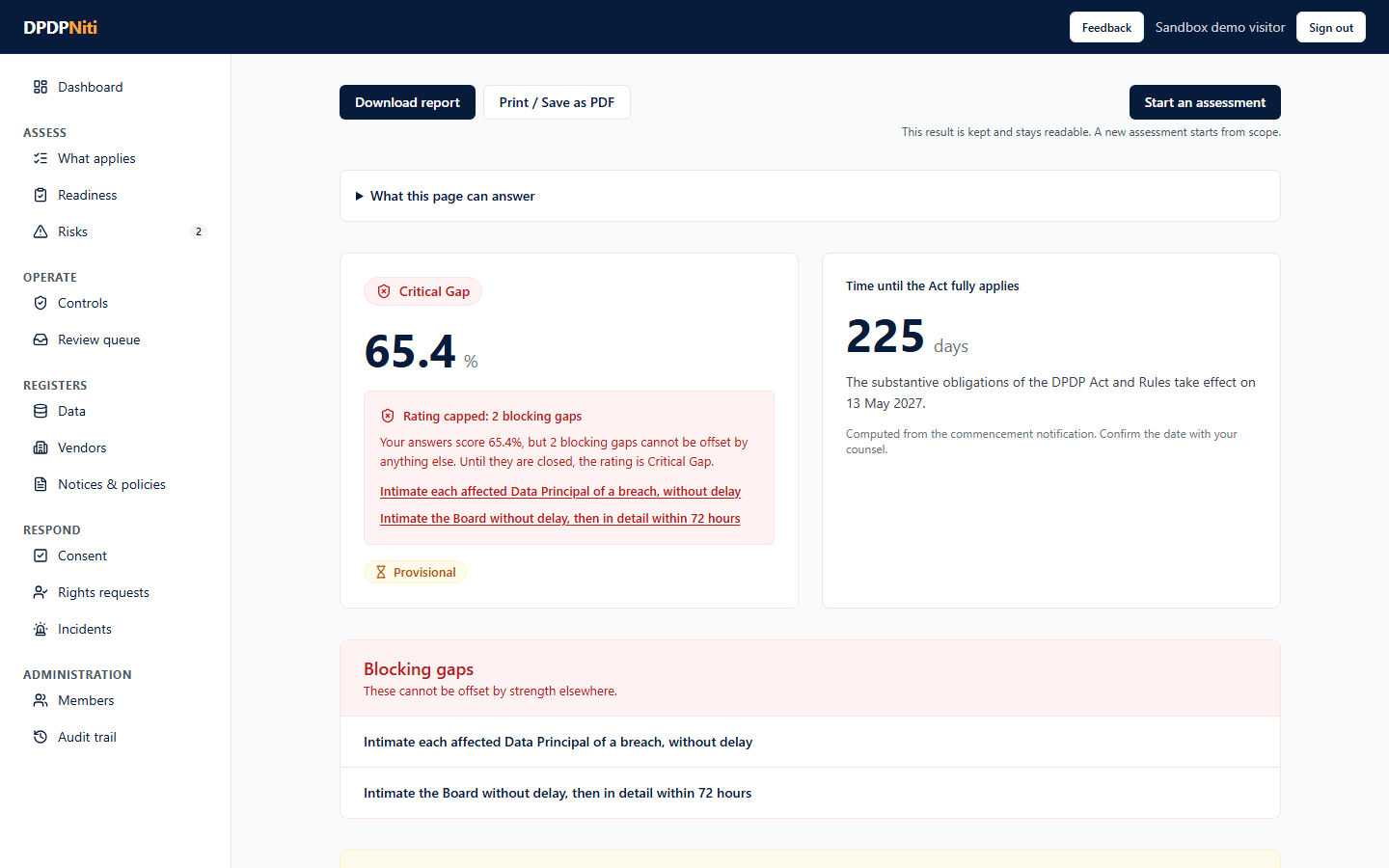
Answer a structured assessment and get a versioned readiness result you can defend: which provisions reach your organisation, where you fall short, and which gaps cap the rating regardless of the arithmetic.
Controls, owners and evidence
Adopt controls against the obligations that apply, give each one an accountable owner, attach the evidence that proves it, and route that evidence through a review queue with an expiry that is derived, never stale.
Registers of your data reality
A data inventory built from a starter set of data categories and the purposes, systems and data stores you register; a vendor and processor register with the contracts behind it; and notices and policies that version, approve and publish.
Consent management
Define the purposes you ask consent for and publish each version, record every grant and withdrawal, and keep the consent register, person by person. A Data Principal can withdraw on a hosted page, through a link you give them.
Rights requests and incidents
Intake, identity verification, classification and closure for Data Principal requests, and the same discipline for personal data breaches — each transition recorded, none of them a free-text status field.
Risk, remediation and acceptance
Findings become risks with inherent and residual scoring against measured control effectiveness, remediation tasks that track effort, and a risk acceptance that is a recorded decision with a name against it.
Executive view and audit trail
Seven tiles that count honestly, each carrying the basis it was calculated on, over an append-only audit trail recording who did what, when, and what changed.
Multilingual noticesComing· Phase 2
A notice lifecycle across English and the 22 languages of the Eighth Schedule — the option the Act itself gives the Data Principal. Not built yet; on the roadmap and scoped.
How it works
From obligation to evidence
Four steps that put compliance work where it belongs — in a system of record rather than a spreadsheet nobody owns.
- 01
Find what applies
Answer a scoped assessment. Applicability rules decide which provisions reach your organisation, and say so — including the ones that need a human decision.
- 02
Assign controls and owners
Adopt a control against each obligation, name the accountable owner, and set the review cadence the control actually needs.
- 03
Collect and review evidence
Contributors attach evidence to the requirement it satisfies; a reviewer approves or rejects it; expiry is derived from the evidence itself, so cover lapses visibly instead of silently.
- 04
Report and prove
A dashboard of honest counts, a readiness result with its decomposition, and an append-only record of every action behind them — exportable when someone asks you to show your work.
How it is built
The guarantees a privacy team will ask us about
Stated at the level they are actually enforced — and where something is not built yet, it says so.
Tenant isolation in the database
Every tenant-owned table carries PostgreSQL row-level security, and the application connects with a role that cannot bypass it. Isolation is a property of the database, not a filter the application remembers to add.
Append-only audit trail
Important actions are recorded with actor, tenant, timestamp and before-and-after state. Neither application role holds an UPDATE or DELETE grant on the audit table, and a trigger refuses the write if anything reaches it another way.
Roles, permissions and MFA
Authorisation is enforced on the server for every route: identity, tenant, role, permission, resource, action. Accounts enrol a TOTP second factor, and the interface never stands in for the check.
Enterprise SSO and SCIMComing
Single sign-on against your identity provider, and directory-driven provisioning. On the roadmap for the Enterprise tier; not available today.
We publish what we have not done as carefully as what we have. The security page names our current certifications — there are none yet — alongside the controls that are in place.
See it against your own obligations
A walkthrough of the real product — the assessment, the controls, the evidence and the audit trail — with the roadmap shown as the roadmap.
Scheduling opens Calendly, a third party who will see what you enter there. Email reaches us directly and this site records nothing either way.