The Complete Operating System for DPDP Governance
Statutory obligations become controls with owners, evidence with reviewers, and a record you can put in front of an auditor.
The Traceability Engine
From statute to evidence, in one unbroken chain
Follow any obligation through the full lifecycle. Select a stage to see how DPDPNiti links regulation to real, auditable proof.
Regulatory Act
DPDP Act, 2023The statutory source. Provisions of the Act and the Rules are held as versioned content with the Gazette citation, the publication date and the retrieval date recorded against each one — and a summary is always labelled as our summary, never as the statute.
The actual product
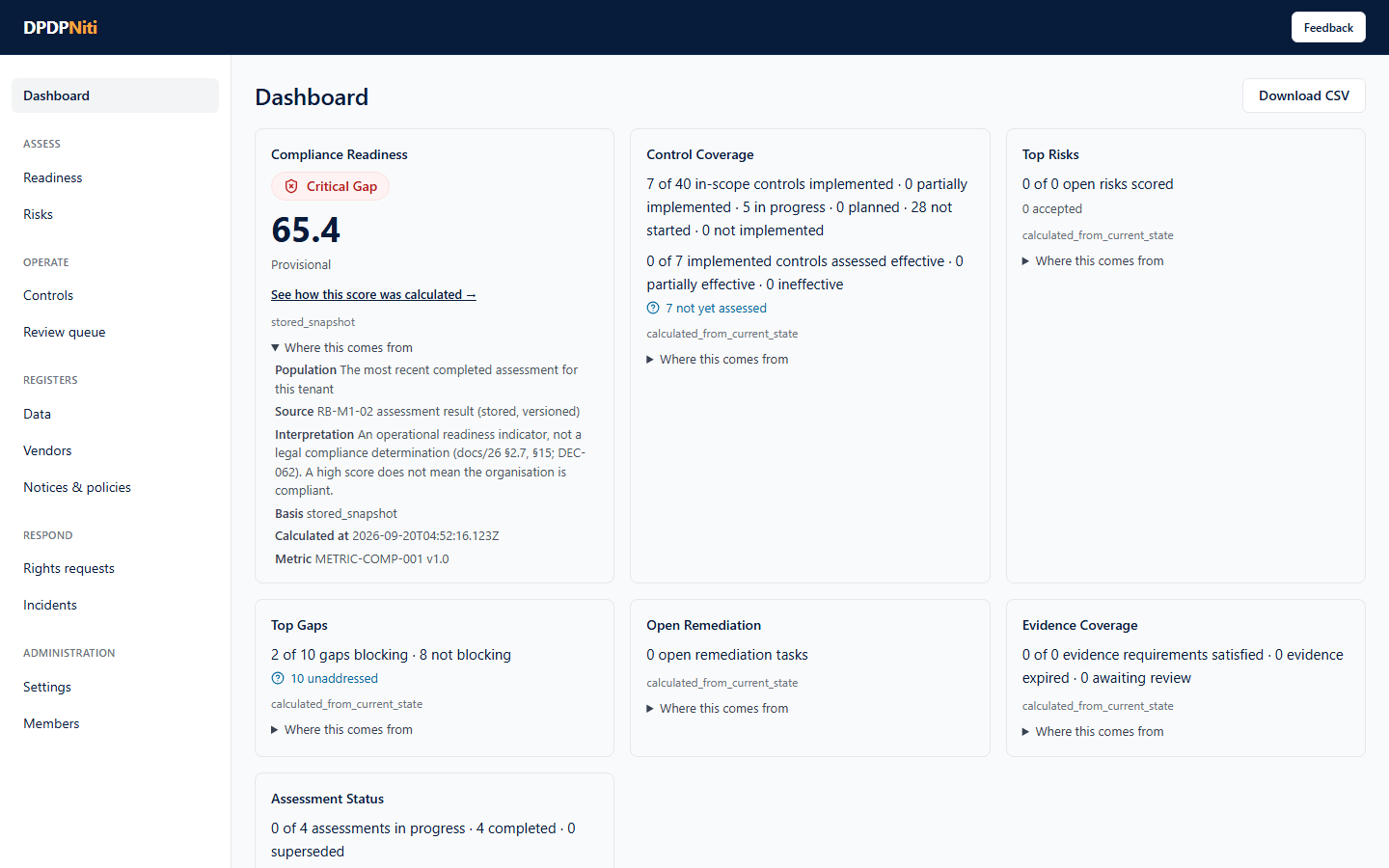
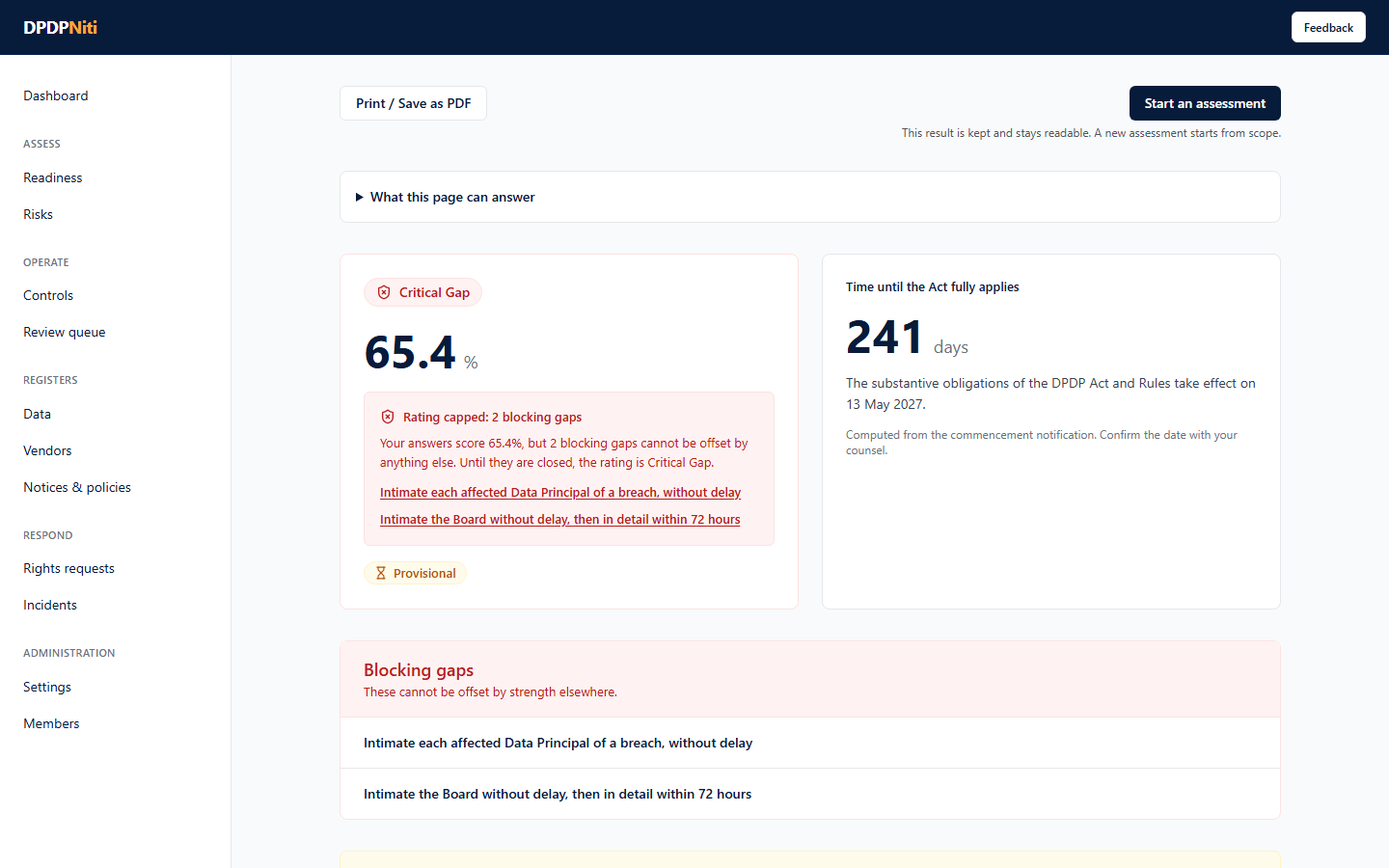
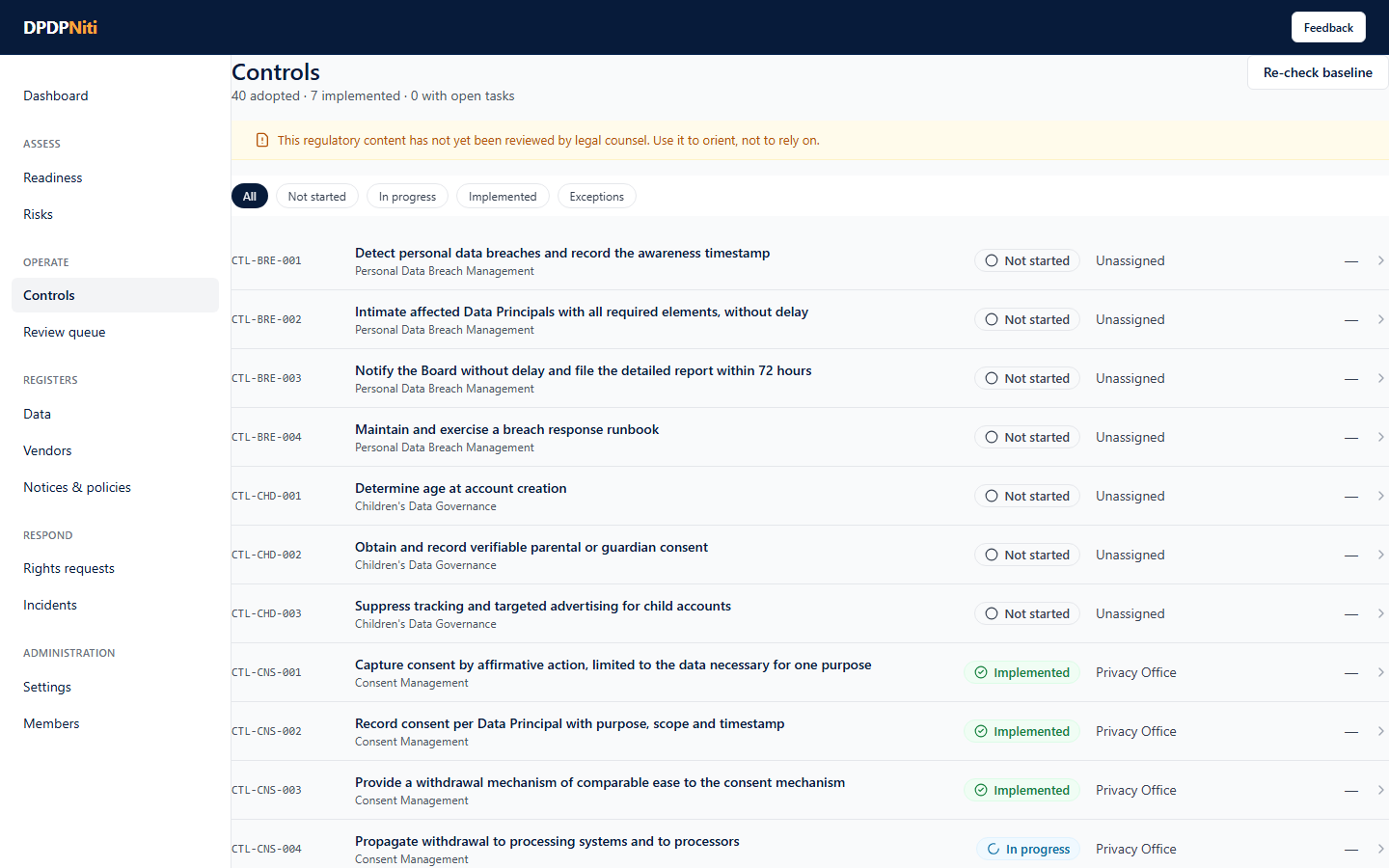
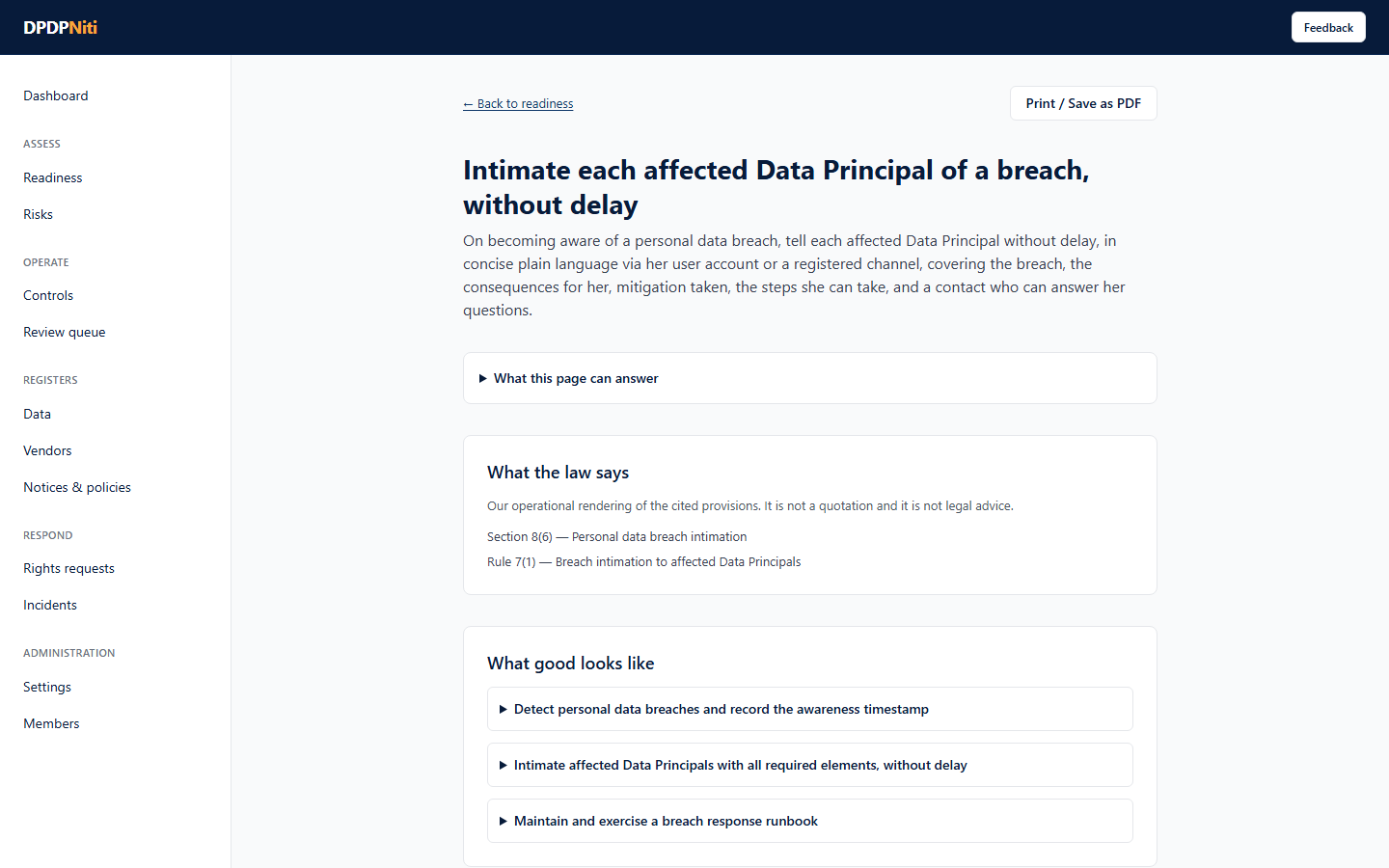
Screens, not mock-ups
Captured from a synthetic organisation in the running product. Nothing here is drawn, composited or retouched.
Core capabilities
Five modules that are running, and one that is not
These are the product's own headings. The roadmap tab is marked so you can tell the difference without booking a call.
Applicability, assessment and readiness
Decide what the Act actually asks of your organisation, answer it once, and keep the answer — versioned, decomposed and defensible.
- Scope questions drive applicability rules; a provision that cannot be decided from the rules says so instead of guessing
- A stored, versioned readiness result with the scoring model recorded against it
- Blocking gaps cap the rating regardless of the arithmetic, and the cap is shown
- Re-assess later without destroying what the last one said
One application, one tenant boundary, one audit trail. Every module reads the same records rather than keeping its own copy.
Deployment and architecture
How it runs, stated plainly
One deployment model today and one on the roadmap — told apart on the page rather than in a sales call.
Deployment
Managed SaaS
The way DPDPNiti ships today: multi-tenant, hosted by us in India, updated continuously, with no infrastructure for your team to run.
Private deploymentComing
The same containers as an annual term licence for organisations whose policy requires their own infrastructure, with a signed licence file carrying the tenant, the tier and the entitlements. Designed and decided; not available today.
Regulatory content updates
The corpus of provisions, obligations and controls is versioned content with its own release trail, so the law moving does not mean your platform standing still.
Hosted in India
Production runs in the Mumbai region. The Act does not broadly mandate localisation today, and we do not claim it does — we host here because Indian buyers ask, and because transfer restrictions may yet arrive for Significant Data Fiduciaries.
Isolation enforced by the database
Row-level security on every tenant-owned table, with an application role that cannot bypass it and a separate, narrowly scoped role for tenant resolution. A forgotten WHERE clause returns nothing, not somebody else’s data.
A documented REST API
Every screen in the product is built on the same versioned REST API, published as an OpenAPI document, authenticated and permission-checked exactly as the interface is.
See it against your own obligations
A walkthrough of the real product — the assessment, the controls, the evidence and the audit trail — with the roadmap shown as the roadmap.